

Undervalued & Undersold
#2 A Justice that simultaneously vindicates victims and comforts culprits

This is the second part of a series on ‘undervalued and undersold’ elements of the Christian life - things we appreciate, and thus advertise, too little. You can read the introduction to the series, along with the first ‘Christian commodity’ here.
This is the second: A Justice that simultaneously vindicates victims and comforts culprits:
Justice or Mercy?
A couple of weeks ago, I had a rare joy - I was invited to a birthday party. That’s not the rare part, I am regularly at birthday parties, though I normally play the part of the parent trying not to contract whatever is currently incubating in the ball pit. What made this an uncommon joy is that the ‘birthday boy’ had decided he wanted to host a full read-through of Hamlet, and invited friends to come and play various parts.
I, Claudius, was sat next to the Ghost (traditionally played by the same actor), and, as such, was able to focus better on the meaning of his lines than on my own - most of my concentration was given to trying to limit how many different pronunciations of Laertes were coming out of my mouth. The Ghost, the murdered victim and brother of my character, will show us both halves of the problem with which this article engages: namely that of victims who see no justice, and perpetrators yet to experience it.
“Cut off even in the blossoms of my sin,
Unhousel’d, disappointed, unanel’d,
No reckoning made, but sent to my account
With all my imperfections on my head.”
Hamlet’s Father was killed mid-sin, with no chance to confess it - no last rites, no settling of his own account. Whatever wrong he’d done in life went with him unresolved, without divine forgiveness or the ordinary human mercy of time to make things right, and now he is
“Doom’d for a certain term to walk the night,
And for the day confin’d to fast in fires,
Till the foul crimes done in my days of nature
Are burnt and purged away.”
But he is not, evidently, solely a perpetrator of wrong - but a victim of murder most foul - murdered by his own brother, in his sleep, in a garden, and there has been no trial, not even an investigation, or a suspicion spoken aloud. No justice sought or done. Nobody has answered for his fate.
So, the ghost plays a part familiar to each of us: I, too, am a perpetrator of wrongs that have seen no justice, and I am also a victim without vindication. How can I rest?
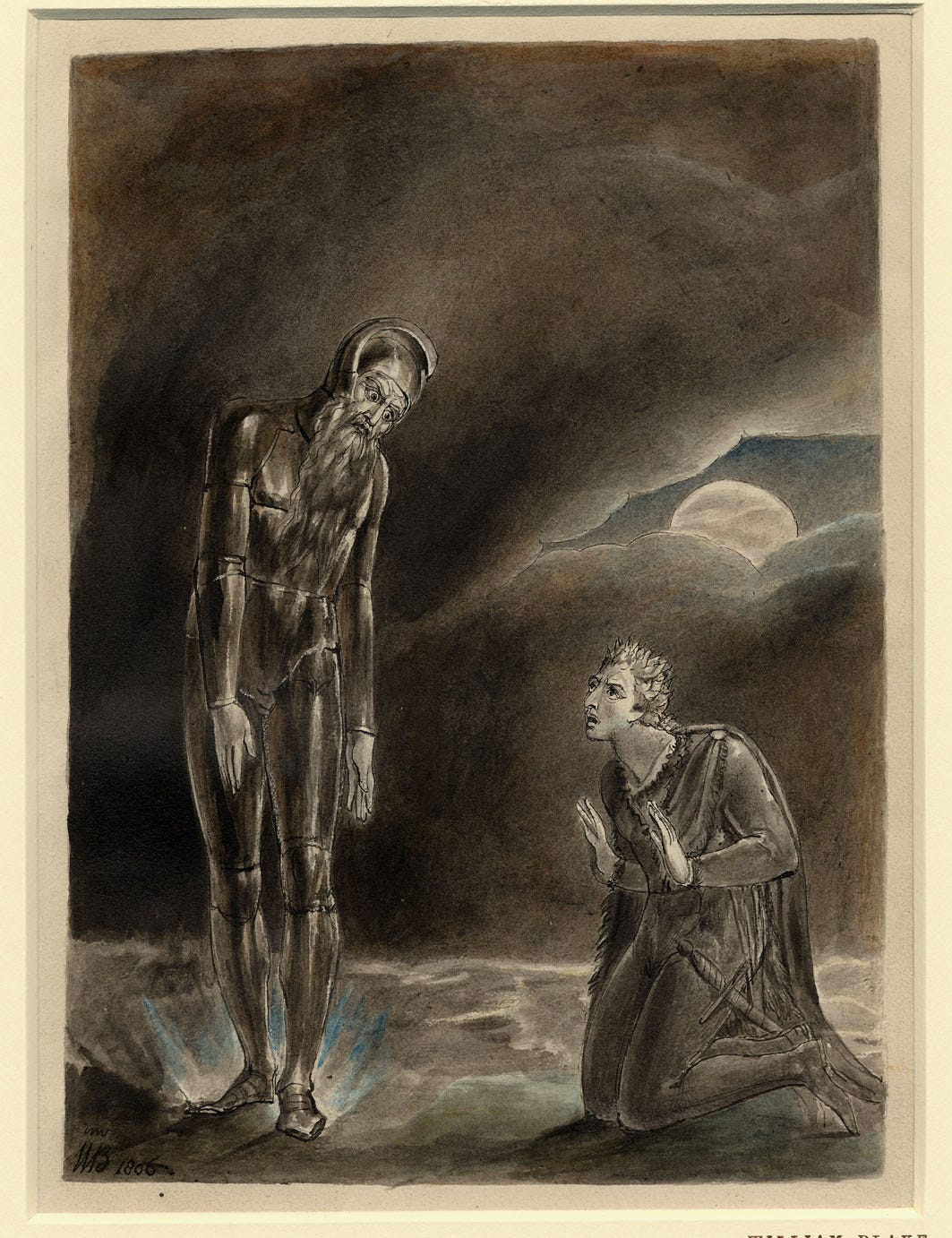
You see, reader, you have been hurt. You may be hurting now, and you will certainly be hurt again as, if not before, you die. Also, dear reader, I don’t want to spook you with my insights into your soul, but you have done terrible things. Some may have been illegal, but at least those carry the catharsis of human punishment. The things that make you clench every muscle in your body when you think on them, are the ‘small’ wrongs you committed that did genuine harm, and for which there is no recourse for fixing or reconciling.
And as for the damage done to us… we often don’t even know what wounds we carry till we catch them on something. Just a few months ago I froze briefly in the pulpit when my brain told me that the man who had just entered late, was a particular man from my past. I was temporarily paralysed even though I knew it couldn’t be him - I had to force my eyes to look directly at this (I’m sure perfectly charming) stranger in order to unpetrify my limbs. We are hurting, one way and another, are we not?
The Trial
In that hurt, the Christian has a place to turn (and someone to turn to - we’ll get to Him). Specifically, I will often turn to Ecclesiastes, which has offered hope in the most turbulent moments of my life, and, scattered throughout, there is a peculiar thread in which the whole world can quench its thirst for justice. I will focus on two of the verses which deal with this: 12:14 and 3:15.
"For God will bring every deed into judgment, with every secret thing, whether good or evil" and "God requireth that which is past." (Please forgive the mix and match of translations). The Teacher's language is that of the courtroom: God summons back what has gone, subpoenas the moment itself, and requires its presence before him. Nothing is exempt on the grounds that it is over. The small things you got away with, that still nag at you in the dark — they have been served. The vicious moments you endured, that seemingly meant nothing to those who caused them — those too, served. Every moment that has ever occurred will be compelled to answer for itself, before a judge who stands entirely outside of time, unbound by its jurisdictions.
For the Christian, your peace does not depend on your being able to remember all you've done, and marshal it in confession before God beats you to it. When we confess, we confess a state of sin, and are declared righteous on that basis, not on the basis of a completed inventory of wickedness. So when these moments are eventually called before God, and every deed and secret thing is dragged into the light, God will say two things about me at once: that my action was evil, the moment abhorrent, and that I am righteous. And this will not be a contradiction, but a statement of extreme and total truth, as the penalty is already paid, measure for measure.
So too for the moments in which you were harmed, even those in which you were harmed by those who have been forgiven. You don’t get a letter through the post that says that as part of a plea bargain, the wrongs done to you will not be investigated or tried. No - the wrong, say, that I have done you, though I am forgiven, will still be played out before a judge, and a sentence will be read out. As all moments are called forward, the moment of Christ’s execution will be brought there also, and when you see me walk free, you will know it is not because what I did doesn’t matter, but because it mattered enough for the Son of God to die.
You will be vindicated for the wrong done to you.
This is peace for the walking wounded, and for the wounders who walked free.

Where else will you see this!? Where else will you see a case where victim, perpetrator, judge and law might all be placated?
Secular forgiveness, at its most generous, asks you to simply let it go — which is not vindication, it is unilateral disarmament, and everybody who has tried it knows the wound does not care how magnanimously you've decided to stop mentioning it. But by his wounds we are healed.
Yet how little we marvel at the magic of this. We once walked with the double limp of guilt and grievance, now we may walk with the poised gait of those who neither fear judgement nor fret that it may never come. If we walk in this way, those who limp around us, otherwise ‘doomed to walk the night’ will surely beg us for the cure, and we will stand ready to give it.
Love bade me welcome. Yet my soul drew back
Guilty of dust and sin.
But quick-eyed Love, observing me grow slack
From my first entrance in,
Drew nearer to me, sweetly questioning,
If I lacked any thing.
A guest, I answered, worthy to be here:
Love said, You shall be he.
I the unkind, ungrateful? Ah my dear,
I cannot look on thee.
Love took my hand, and smiling did reply,
Who made the eyes but I?
Truth Lord, but I have marred them: let my shame
Go where it doth deserve.
And know you not, says Love, who bore the blame?
My dear, then I will serve.
You must sit down, says Love, and taste my meat:
So I did sit and eat.
Love III, George Herbert